The Quiet Power of Putting It Into Words
What three decades of research tell us about journaling — and why IFS makes sense of all of it
There is something almost deceptively simple about sitting down with a notebook and writing what's on your mind. No special training. No audience. Just you, a page, and whatever you happen to be carrying. Yet some of the most compelling findings in modern health psychology suggest that this ordinary act can do something quite extraordinary: it can help you feel better — physically, emotionally, and psychologically.
If you're familiar with Internal Family Systems, you may find yourself nodding as you read what follows. The research and the model, it turns out, are pointing at the same thing.
Where it all began — and what inhibition really costs
In 1986, psychologist James Pennebaker and his graduate student Sandra Beal ran a study that would quietly reshape how researchers think about emotion and health. Over four consecutive days, college students wrote for fifteen minutes each day about the most traumatic experiences of their lives, while a control group wrote about neutral, superficial topics.
The results were striking. Students who wrote about their traumas visited the student health centre over the next six months at roughly half the rate of those in the control condition.
Pennebaker's explanation centred on the idea of inhibition — that the act of holding back thoughts, emotions, or behaviours is associated with a low-level physiological cost, much the way chronic stress burdens the body. Writing offered a way to release that held tension.
IFS would call this something familiar. When parts of us — particularly those carrying pain, shame, or fear — are locked away or silenced, the system doesn't rest. Protectors work hard to keep those exiles contained: managing, distracting, numbing, staying busy. That effort has a cost. Pennebaker was measuring, in health centre visits and stress physiology, what IFS practitioners witness in the therapy room every day: the burden of a system that cannot yet let itself be known.
Critically, participants who wrote only about the facts of a trauma — without including their feelings — showed no improvement at all. This is not a footnote. This is the whole story. Facts, recounted without emotional contact, are what a protecting part produces when it's doing its job: keeping the real material at arm's length. The healing came when something softer broke through — when the exile was finally allowed to speak.
A decade of studies, confirmed — what gets better when parts feel met
By 1998, enough researchers had followed Pennebaker's lead to allow for a formal stocktaking. Psychologist Joshua Smyth conducted a meta-analysis of thirteen expressive writing studies and found something worth pausing over.
Health was enhanced across four distinct outcome types: self-reported physical health, psychological well-being, physiological functioning, and general functioning. The average effect size of d = 0.47 indicated a significant, medium-sized benefit from a practice that is, after all, remarkably brief and inexpensive.
From an IFS perspective, this breadth of benefit makes sense. The model describes the Self — that calm, curious, compassionate core in each of us — as the natural healer of the system. When Self can turn toward a burdened part with genuine presence, rather than pushing it away or being flooded by it, parts begin to unburden. And when parts unburden, the whole system regulates differently. Sleep, immune function, mood, energy — these aren't separate domains; they're expressions of a system that is, or isn't, at war with itself.
Smyth's four outcome categories map almost elegantly onto what IFS predicts would shift when protective strategies loosen: the body settles, emotional life becomes more spacious, physiological arousal reduces, and daily functioning improves. Journaling, at its best, is a form of Self-led witnessing in writing.
Getting more specific about mood — and why structure matters
In 2018, Reinhold and colleagues published a meta-analysis of 39 randomised controlled trials focused specifically on whether expressive writing eases depressive symptoms. They found a small but significant decrease in symptoms immediately following the writing practice.
But the more interesting finding was about how to journal. Expressive writing was more effective when the number of sessions was higher, when sessions were longer, and when instructions were more directive — or included a specific writing topic.
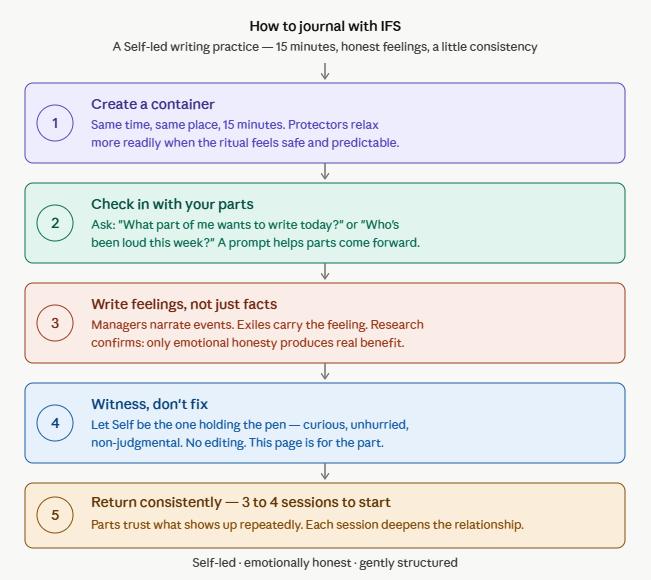
IFS practitioners will find this entirely intuitive. Parts don't generally open on demand. They need to sense that it is safe to do so — that they won't be overwhelmed, dismissed, or made to feel worse for showing up. A specific prompt, a consistent time, a structured container: these are the conditions under which a part begins to trust that Self is actually here and paying attention. Open-ended free-writing can work, but it often keeps things at the surface — the managers offering their familiar commentary, the exiles staying well back.
Reinhold's finding is, at its heart, a finding about relationship. The more you show up — consistently, with intention and structure — the more your parts believe you mean it.
Writing as a practice of Self-led presence
Put all three studies together and a coherent picture emerges — one that IFS makes unusually legible.
Journaling works not because it empties you out, but because it creates a moment of genuine internal contact. When you write with emotional honesty, something in you is turning toward something else in you with curiosity and care. That is, in IFS terms, Self meeting a part. The part doesn't need to be fully understood or resolved. It needs to be seen — acknowledged, not analysed; witnessed, not fixed.
Pennebaker showed us that suppression has a price. Smyth showed us how widely the body and mind benefit when that suppression softens. Reinhold showed us that the practice deepens when it is regular, structured, and emotionally engaged.
None of this requires you to be in crisis. These studies were largely conducted with ordinary, healthy people — not those in acute distress. The invitation is simply this: sit down, find a part that's been knocking quietly on your awareness, and let it speak for fifteen minutes. No editing. No audience. Just you, acting as a compassionate witness to your own inner life.
That, it turns out, is enough to change things.
Sources: Pennebaker & Beal (1986), Journal of Abnormal Psychology; Smyth (1998), Journal of Consulting and Clinical Psychology; Reinhold, Bürkner & Holling (2018), Clinical Psychology: Science and Practice.
NOTE
The Pennebaker inhibition theory maps almost one-to-one onto what protectors do — which felt like the cleanest integration in the piece. Smyth's four health domains became a way of describing what a less burdened system looks like systemically, rather than just psychologically. And Reinhold's moderator finding — that structure and consistency matter — became an argument for the relationship between Self and parts needing to be earned over time, not assumed.


Comments